


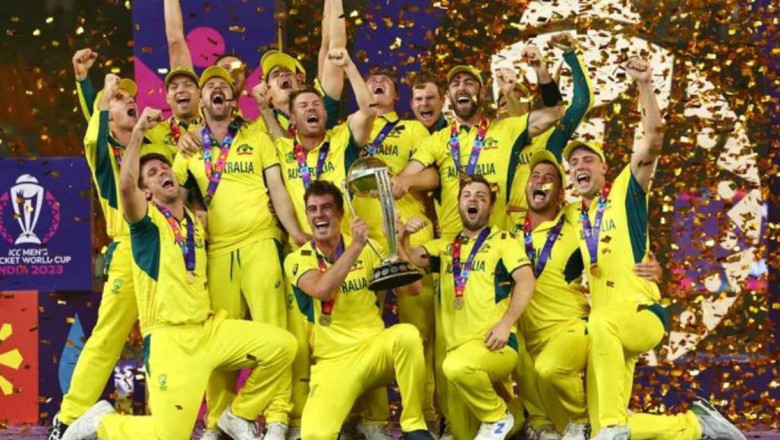

Australia has won the ODI World Cup six times overall, having done so five times previously in 1987, 1999, 2003, 2007, and 2015. Australia, who were supposed to chase a modest 241, easily scored the winning runs in 43 overs thanks to Head and Labuschagne's match-winning partnership at the fourth wicket. Australia got into trouble early in the run chase when they were reduced to 47/3 in just seven overs, with experienced batsman Steve Smith (4), in-form opener David Warner (7), and Mitchell Marsh (15) all going down quickly. India, riding a 10-match winning streak, was hoping to defend a low score and win their third title, but Head crushed their dreams. With a 192-run partnership with Marnus Labushagne, the left-handed opener put Australia within striking distance of their record victory. Labuschagne batted carefully to ensure he did not lose his wicket, but Head was the main aggressor of the outstanding stand. The opener, however, could not score the winning runs for his team as he smashed a short delivery from Mohammed Siraj straight to Shubman Gill at deep midwicket. With an outstanding 137, Travis Head led Australia's score in the ICC World Cup 2023 final. He hit four sixes and fifteen boundaries in his 120-ball knock. Glenn Maxwell, who batted at number five, did not waste any time in pulling Siraj for a couple of runs to give Australia the victory. At 58, Labuschagne, who was instrumental in Australia's World Cup victory, was still undefeated. He hit four boundaries out of 110 deliveries. Siraj and Shami each managed a wicket, but Jasprit Bumrah claimed two for India. Australia chose to bowl first, and with just 30 runs needed, Mitchell Starc got rid of Shubman Gill (4) to give his team the early advantage. Nevertheless, Indian captain Rohit Sharma persisted in his assault, scoring 46 runs with Virat Kohli for the second wicket before being out of the game due to an outstanding catch by Travis Head off Glenn Maxwell. With four boundaries and three sixes in a rapid 47 runs off of 31 balls, Sharma displayed his skill. In the 11th over, with the scoreboard reading 81-3, Australian captain Pat Cummins claimed his first wicket as Shreyas Iyer (4) walked back to the pavilion. After that, KL Rahul and Virat Kohli stitched together a cautious 67-run partnership for the fourth wicket, pushing India's total to 148 before Cummins bowled Kohli out to quiet the stadium's packed house. With four boundaries and 63 balls, Kohli scored a strong 54 runs. Australian bowlers prevented Indian hitters from scoring easily by maintaining their side's lead through methodical bowling. KL Rahul top-scored for India with a scratchy innings of 66 runs from 107 balls with a single boundary before getting caught behind off Mitchell Starc leaving his side reeling at 203-6 in the 42nd over. Then, with wickets falling at the other end, Suryakumar Yadav put up a shaky eighteen runs off twenty-eight balls until Josh Hazlewood caught him behind with a slower, short-pitched delivery.
With one ball left in the Indian innings, Yadav was run out by Australian bowlers with 240 runs on the board. With three wickets, Starc overtook Kuldeep at the wickets chart, while Cummins and Hazlewood each claimed two wickets.













Comments
0 comment